One
The spark
A novella does not start as a plot. It starts as a pressure: an image that will not leave, or a question that keeps arriving in different clothes. What a publisher can say is what the book keeps asking once it is open. Read from the outside, the question looks small and stubborn: what happens to careful people, more at ease with books and questions than with being seen, when they are finally looked at properly?
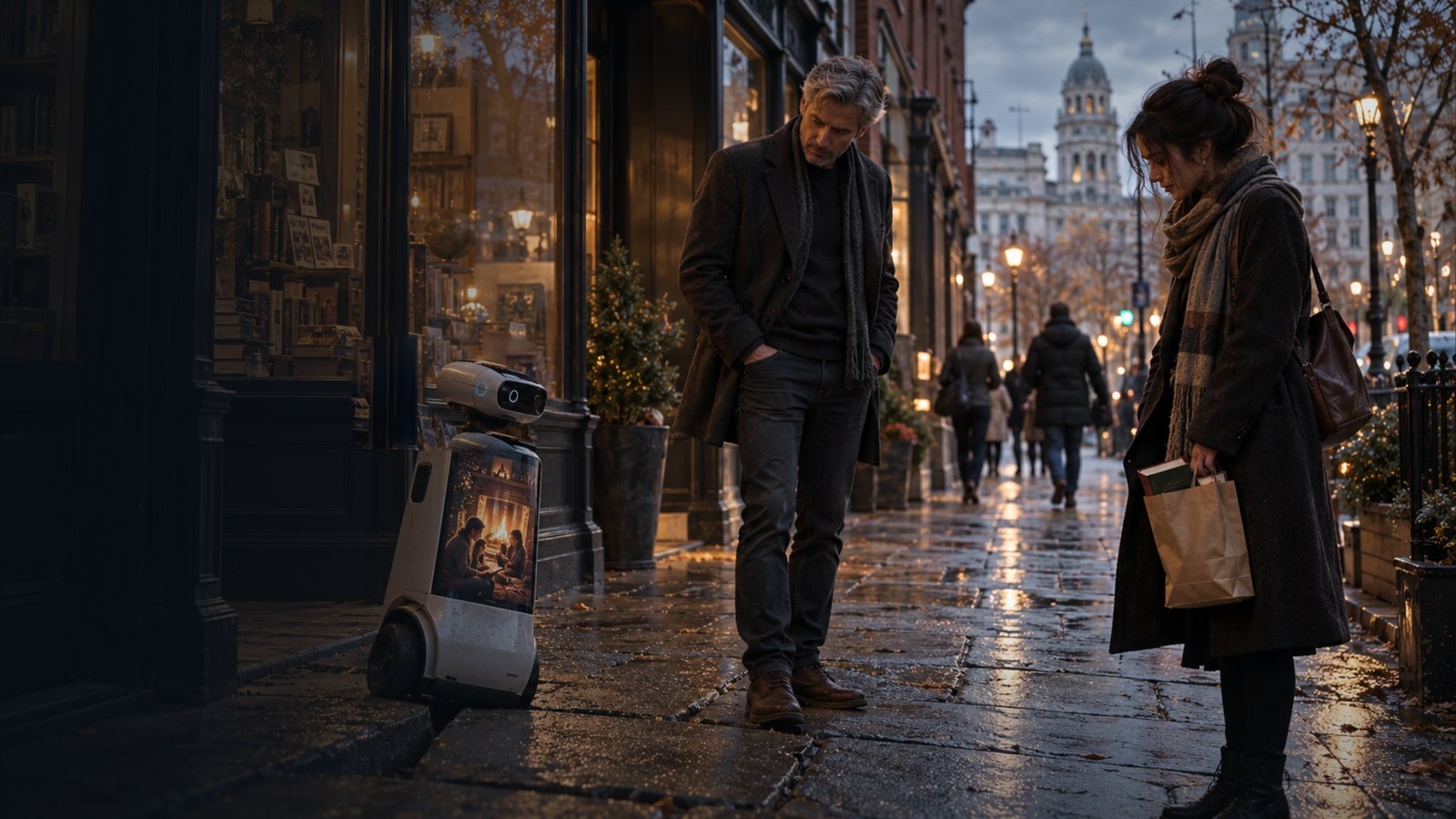
The scene the book opens with is the one you can read on this site: a bookstore in Denver, a stranded machine selling nostalgia for human-made things, and a man who stops. It opens like this.
The machine had been stuck outside the bookstore for nearly an hour.
From scene one of First Love, the published sample.
Two
The people and the place
Two things are on the record. The book is a novella in 10 scenes, about 13,800 words. And it is set in a future close enough to ours that a machine can be stuck outside a bookstore, selling the memory of books. The rest of this part is interpretation, and we mark it as such.
Our reading: the world of First Love is built to answer to its people rather than the other way round. What exists in it exists to make one cost real, the cost of being ordinary and unnoticed, and each of the ten scenes has to move its people closer to being seen, or show the price of not being.
Three
What the record shows
A book's revision history is the most tempting thing to invent and the easiest to get wrong, so this part sticks to the publisher's record. The text of First Love exists in numbered editions held by the publisher. One of them was approved by the author for release, on a recorded date, and that edition, and only that edition, is the one behind every page on this site. No other version is quoted or described here.
Before release, the publisher's editorial review read the approved edition against a simple standard: does this sentence belong to these people, in this room, at this hour? The notes from that review are the publisher's.
Four
The difficult questions
Some choices cannot be settled by craft. How much of a character's grief belongs on the page, and how much is theirs to keep? When is ambiguity honest and when is it an escape? What does a person owe to work that may do harm, and can a love story carry that question without becoming a lecture?
These are our questions as readers, not a report of the author's. What we can say from the text is that First Love tends to decide them on its characters' behalf rather than the reader's: it gives Andrew his silences and lets the reader sit in the same uncertainty he does. Where the book declines to explain itself, we read that as a decision.
The hardest edits are seldom sentences. They are permissions: what a story is allowed to leave unsaid.
A publisher's editorial note. It is our view, not a statement by the author.
Five
From page to experience
A finished manuscript still has to be met. We built a private reading room for First Love rather than a file, so that the book could decide how it is approached. On a large screen it opens in a rich mode: the first scene arrives slowly, with a quiet moving picture of the street outside the bookstore, and the text takes over once the reader has settled. On a phone, or for anyone who prefers it, a classic mode gives the same words in a plain column.
The room keeps your place without an account. It lets you annotate privately; your notes stay in that browser, on that device; nothing is synced between devices, and nothing leaves the device unless you explicitly choose to send your notes to the publisher. It respects a reader who has asked their device for less motion. The typography was chosen so that about 13,800 words can be read in an evening without the eye tiring: a text serif with real italics, generous measure, and headings that know when to be quiet. The room exists, has been tested, and is opening to its first invited readers.
Six
The reader's place
First Love is going to its first readers now, by personal invitation from the publisher. The room was built for them: it keeps a reader's place, keeps their notes private to their own browser, and sends nothing to the publisher unless the reader chooses to. What a reader makes of the book is theirs. The essay stops at the door of the room; the book goes in alone.
Seven
An invitation
If you have read this far, you probably have a question of your own that keeps arriving in different clothes. It does not need a plan. It needs a first scene you are willing to keep, and the patience to take it apart later. That much is the publisher's advice, offered from the outside. How the house works with every book is set out in Our Process. The best way to begin is to read something made this way, and then to start.
Read the opening scene About the book
This essay is the publisher's. Its facts come from the publisher's release record for First Love; its interpretations are labeled as ours. It is not a certification of how any book was made.